
The Artist's Table
Art by Rebecca J. Hartman

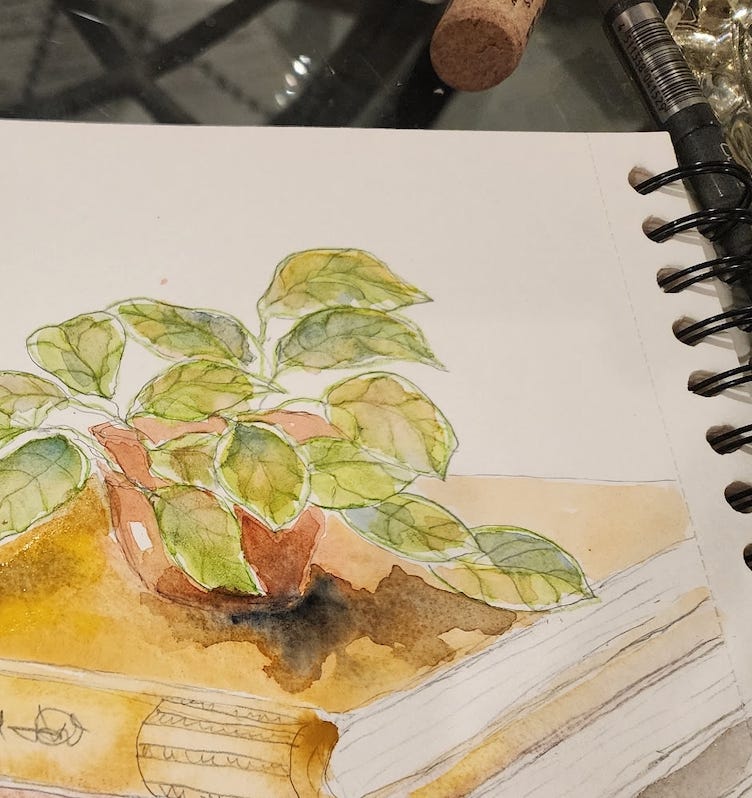
“A writer [artist] should concern himself with whatever absorbs his fancy, stirs his heart, and unlimbers his typewriter.”—E.B. White
I watched a few videos about learning to play Mahjong before realizing that the complicated game doesn’t “stir my heart.” The realization led me to consider what does, and of course, I realized for the umpteenth time (since I first fell in love with Robert Frost in the third grade) how words, ideas, writing, and reading “absorb my fancy.” It’s not an exciting life, but it’s deep and gentle, and it’s mine.
I recalled Emerson’s idea that if we spread everyone into a circle, but made the mistake of keeping our eyes across the circle on someone else, imitation would eventually become suicide; we would erase our true selves and negate our spot on the circle.
We all have our own spaces to guard and govern.
Lately, I’ve had trouble connecting my space to much that surrounds me, and I write that off to a general malaise and disconnect that rises from an absurdity that’s bound to collapse, eventually, under its own weight.
In the meantime, novels can sometimes work to mitigate the disturbance of news, AI, or social media; Whistler, by Ann Patchett, for example, divides nicely into chapters of soft intrigue, and is quite a boost to the spirit. And there are the old standbys—Rachel Peden’s Rural Free, which can be read again and again, or E.B. White’s essays. These are old-fashioned, yes, but timeless, too.
I recently re-read E.B. White’s response to a man who had “lost faith in humanity.” White assured him that “as long as there is one upright man, as long as there is one compassionate woman, the contagion may spread and the scene is not desolate,” adding, “I shall get up Sunday morning and wind the clock, as a contribution to order and steadfastness.”
We all have our own parts to play.
Toni Morrison extended the idea of individual agency: “If there’s a book that you want to read, but it hasn’t been written yet, then you must write it.” These calls to action go far beyond just art or writing. If there is a business you imagine (that coffee shop/bookstore/flower shop), an entertainment you’d like to see or hear, a painting you’ve envisioned, a sanctuary you’d like to provide for animals or people, then consider how to make these passions come to life.
White believed we have an obligation to be compassionate, helpful, and truthful. He wrote that writers do not just reflect life, they shape it. And isn’t that true for each of us, every day? In the check-out line, in service industries, in child and elder care, in teaching and parenting, in sports and politics, we shape life. If we don’t like how it’s going, we retire to the workshop to reconfigure.
We all have our own artist’s table to attend. We have our own clock to wind.
Being kind, walking the extra steps to help, every little gesture helps.
I lov e Robert Frost, and was fortunate enough to see him when I was 13. He came to my school (1961) and said - not recited - his poetry. You could feel it. When I see you, I will relate a story of that visit.
We all have our own "obligation" (mission, desire, hope) "to be compassionate, helpful, and truthful."
and don't forget to stir the heart.